
Our Products
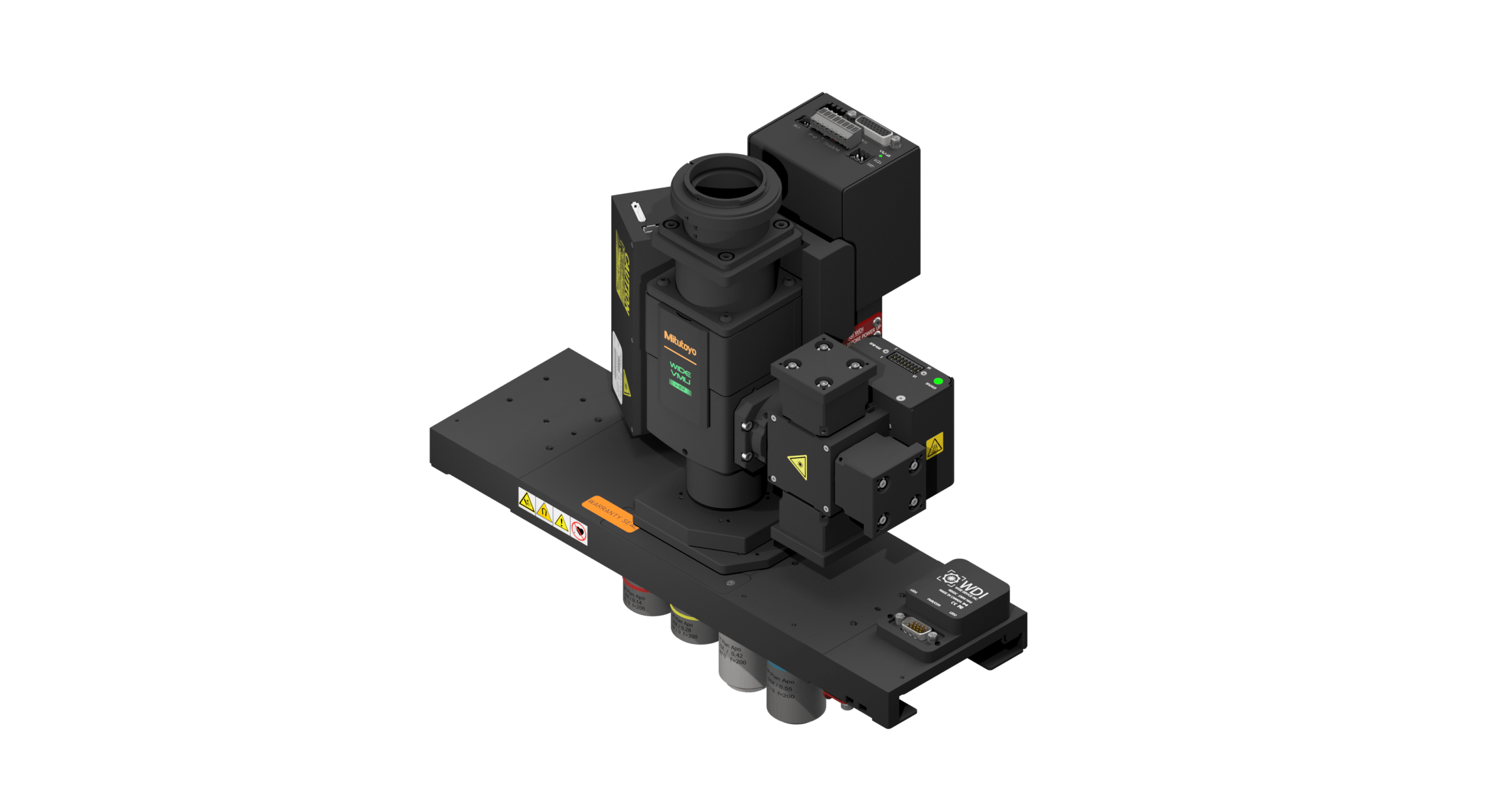
Mitutoyo VMU and WDI Integration
WDI designs and manufactures cutting-edge OEM automated microscopes and precision components tailored for demanding inspection applications. By integrating Mitutoyo Video Microscope Unit (VMU) systems with WDI automated components, existing imaging systems can be transformed into advanced microscopy automation solutions. The native capabilities of Mitutoyo VMU are now expanded by WDI’ integration of precision Z-stages, high-speed laser autofocus sensor, fast linear lens changers, and illuminator options.
 Features
 Features
High-precision motorized Z-stage: Integrated Z-axis enables smooth, programmable vertical movement with up to 40 nm resolution for precise focus control.
Dynamic laser autofocus sensor: Tracks surface variations in real time and maintains focus during high-speed movements.
Automated lens changer: Linear lens changer enables fast and precise switching between objectives.
Advanced illumination: Supports multiple wavelengths from Visible to SWIR with multiple operating modes.
Compact and rigid design: Retains the VMU’s compact, lightweight form while integrating robust hardware for OEM system integration.
Available for Standard, Wide, and Wide HR VMU models.
 Applications
 Applications
- Automated Optical Inspections (AOI)
- Semiconductor and MEMS device inspection
- LCD thin-film and silicon board thickness measurement
- Automated laser peeling, cutting, and defect repair
- Cellular and micro-fluidic analysis