
What Is the Mitutoyo Video Microscope Unit (VMU) and How Does It Work?
The Mitutoyo Video Microscope Unit (VMU) is a compact, lightweight optical unit designed for non-contact dimensional inspection and imaging. It is used in various industries across electronics, semiconductor manufacturing, automotive, materials research, advanced manufacturing etc. The Mitutoyo Video Microscope Unit (VMU) uses precision optics to capture high-resolution, magnified images of a sample for inspection. It achieves this through high-performance objectives, controlled illumination, and aperture stops that work together to produce clear, detailed images.
These Mitutoyo Video Microscope Units (VMU) types cover a wide scope of applications:
- Standard VMU: The standard model used for inspecting micro-patterned wafers, cutting/trimming IC wiring, and monitoring manufacturing lines
- Wide VMU: An improved version used for applications that require increased field of view and area coverage up to seven times larger than standard models
- Wide VMU HR (High Resolution): A special model designed to meet the demands of complex measuring applications with an increased pupil diameter of 16.8mm
These VMU models have been developed to support a wide range of magnifications, optical configurations, and measurement applications. Which makes it a versatile solution for any microscopy and industrial inspection, and where WDI’s OEM components have been specifically engineered to integrate with the Mitutoyo VMU microscope series. Ensuring a seamless integration across the full range of VMU systems as the only microscopy manufacturer offering full ranges of automation components dedicated to the VMU platform. WDI also enables users to fully customize their microscope systems for specific applications while preserving the compact design, accuracy, and performance that define the VMU Series.
Key Applications of the Mitutoyo VMU
The Mitutoyo VMU is designed for a wide range of non-contact inspection tasks across industrial and research environments. When integrated with WDI automation technologies, the VMU microscope system supports enhanced automation, improved workflow efficiency, and flexible system configuration across different application requirements.
Why Choose WDI WISE DEVICE OEM Components for your Mitutoyo VMU?
WDI Wise Device is a world leader in the design and integration of OEM and complete microscopy automation solutions. By integrating Mitutoyo Video Microscope Unit (VMU) models with WDI OEM components, a simple imaging system is then transformed into advanced microscopy automation solutions with improved performance, reliability, and scalability across a wide range of VMU applications.
WDI OEM components are available for the Standard, Wide, and Wide-HR VMU models, providing a consistent modular integration path across the Mitutoyo VMU platforms from one reliable source. All configurations are customizable based on application requirements, with or without an autofocus sensor and standalone units. WDI components can also be integrated with third party components depending on the needs of each VMU application.
Providing a complete range of OEM microscope automation components for building customized standalone microscopy systems. Our product includes advanced autofocus sensors such as the PFA-LN and PFA-DT, linear lens changers, coaxial illumination and Z stages, and more. Designed for flexibility and seamless integration, WDI components can be combined to create application-specific solutions and can also operate alongside compatible third-party components.
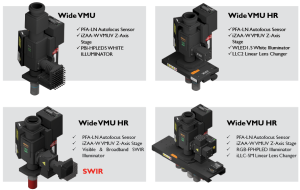
Providing a complete range of OEM microscope automation components for building customized standalone microscopy systems. Our product includes advanced autofocus sensors such as the PFA-LN and PFA-DT, linear lens changers for a wide range of objectives, including SWIR objectives, coaxial illumination, Z stages, and more. Designed for flexibility and seamless integration, WDI components can be combined to create application-specific solutions and can also operate alongside compatible third-party components.
Why Integrate WDI Solutions with Mitutoyo VMUs?
Integrating WDI automation solutions with Mitutoyo VMU systems helps maximize the performance and usability of the measurement platform. Providing automation, autofocus, Z-motion control, illumination and system integration capabilities that help improve workflow efficiency, measurement consistency, and ease of operation.
Speed: WDI laser autofocus sensor operate at a 3 kHz standard sample rate and up to 5 kHz in SWIFT mode. Improved processing power, memory and FPGA-based processing and Gigabit Ethernet communication creating a faster response performance for automated microscopy workflow.
Accuracy: Advanced imaging sensors and processing algorithms providing autofocus accuracy within less than 0.25 of the objective depth of field. Equipped with new multi-segment processing helps maintain stable autofocus performance on complex, patterned, and multi-surface samples.
Integration: WDI OEM microscopy components are designed with simplified optical alignment features and software SDK support for easier integration with Mitutoyo VMU systems. The design supports straightforward mechanical and optical setup within automated measurement environments
Flexibility: WDI automation components, including Z-axis stages, illuminators, and linear lens changers, can be configured with or without laser autofocus functionality. These OEM components are compatible with all Mitutoyo VMU models and support a range of application requirements.
Scalable Automation Platform: The modular design of WDI components allows additional automation functions to be added as application needs evolve. This supports scalable system development without requiring a complete redesign of existing VMU configurations.
Conclusion
Mitutoyo Video Microscope Units (VMU) models provide a proven platform for high-precision, non-contact measurement and imaging for various industries. By integrating with WDI automation microscopy components, users can further enhance their system speed, accuracy, flexibility, and ease of operation. The result is a scalable and future-ready inspection platform capable of supporting a wide range of industrial and research applications while improving productivity and measurement confidence.